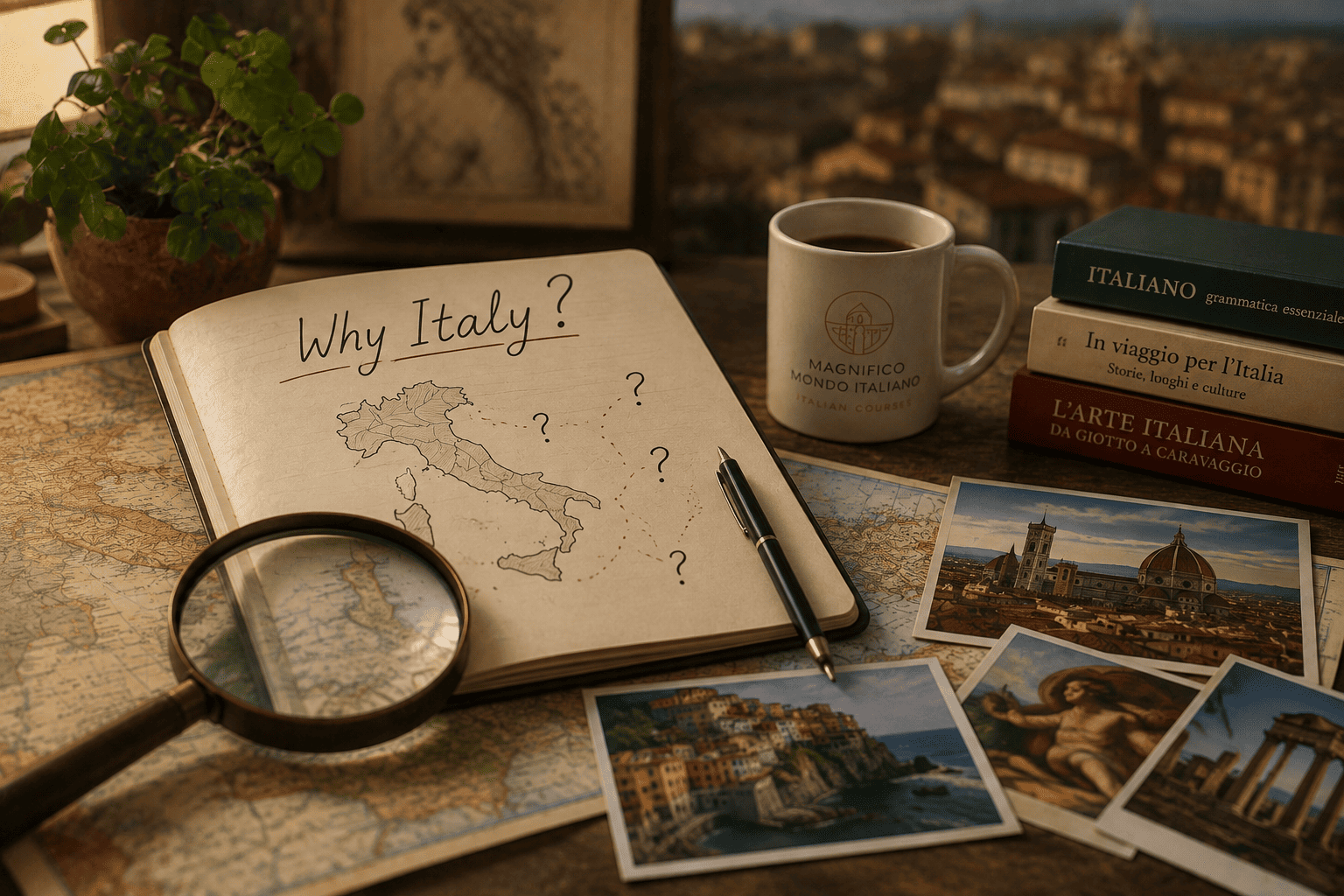
Why Italy?

1

There are questions that, after accompanying us for years, almost seem to disappear. They remain somewhere in the background, quietly, while we continue to work, read, teach. Then, suddenly, a small detail brings them back to the surface and forces us to take them seriously.

And that is what happened to me with a question that, on the surface, seemed quite simple:

Why do so many people decide to learn Italian?

A language you don't choose out of necessity

Over the past few years, I have taught Italian to people from very different countries and cultures. Some wanted to recover a language they had heard in their family as children; others were attracted by Italy through travel, food, art, or music; some had simply reached a point in their lives when they felt the desire to learn a language that, at least in appearance, was not particularly useful for everyday practical needs.

If the goal were simply to learn a language useful for work or communication in as many places as possible, Italian would easily lose out to English, Spanish or Chinese.

Italian is not the most practical language.

Yet in most cases, people do not choose it out of necessity. They choose it because they feel attracted to something that the language represents.

3

A question born in the classroom

Over time, I began to notice something.

Whenever a student told me their story, the language seemed to be only the starting point of something much bigger.

The search was always somewhere else: to understand a country, to read an author in the original language, to give meaning to a journey, to reconstruct a family connection, to get closer to an artistic heritage that had left a mark on their life.

The motivations were very different.

The direction, surprisingly, was always the same.

io lezione 1

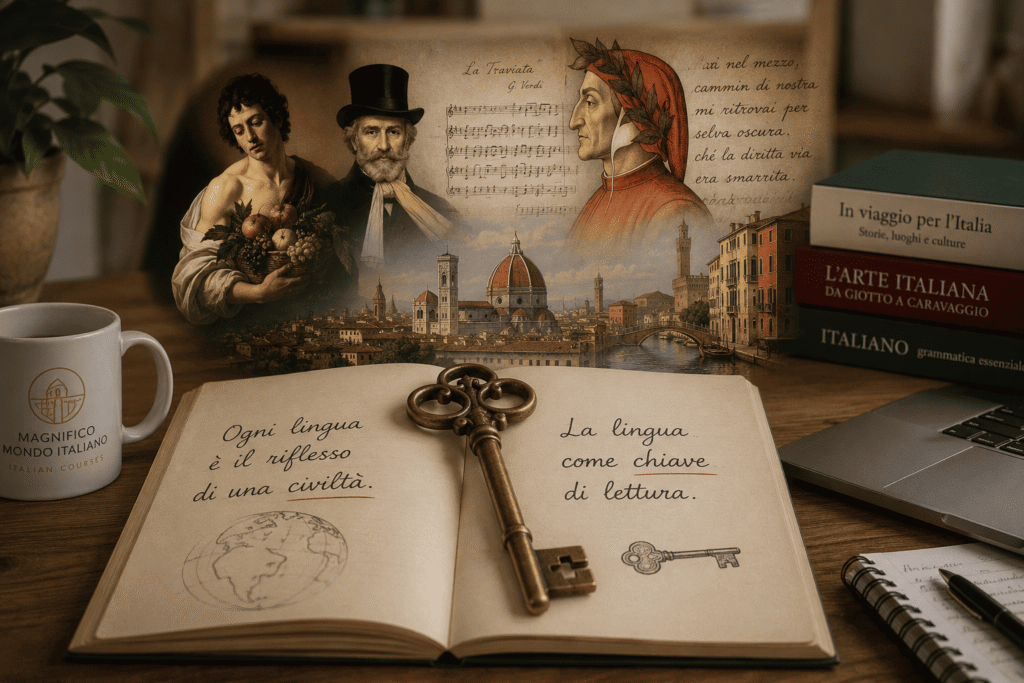
Language as a key to understanding

That was when I began to look at my work differently.

For years, I thought that teaching Italian meant transmitting a language. Today I believe it means, above all, offering a key to understanding.

When we talk about Caravaggio, Verdi, Dante, or the history of an Italian city, we are not simply learning new words. We are trying to understand the cultural context that gave rise to those words, the way a society was formed, and the ideas that still influence the way Italians live today.

After all, every language is a reflection of a civilization.

6

Why this series?

This awareness is where Why Italy? comes from.

Not with the ambition of explaining such a complex country, but with the desire to ask questions that deserve time.

Why did Italy become a unified state so late?

Why does food change so radically from one region to another?

Why do Italians seem to have such a natural relationship with art?

Why can cities just a few kilometres apart seem like completely different worlds?

I don’t know if we will always find an answer. I hope, however, to find better and better questionsBecause understanding a country does not mean collecting curiosities or memorising information. It means learning to observe connections that, at first glance, remain invisible.

Every week, I will publish a new question about what makes Italy… Italy. 

If this kind of exploration interests you too, welcome.

If you would like to receive each new article directly in your inbox, you can subscribe to the newsletter.

Let’s begin.

why italy 2

-10%

Begin your Italian journey with 10% off.

Join Magnifico Mondo Italiano and receive:

• 10% off your first Italian course
• Weekly curated insights on Italian language and culture
• A structured, personalized learning path from day one

Non inviamo spam! Leggi la nostra Informativa sulla privacy per avere maggiori informazioni.

Il tuo carrello
Your cart is empty
Let's start shopping!
Start shopping