WHY ITALY #3:
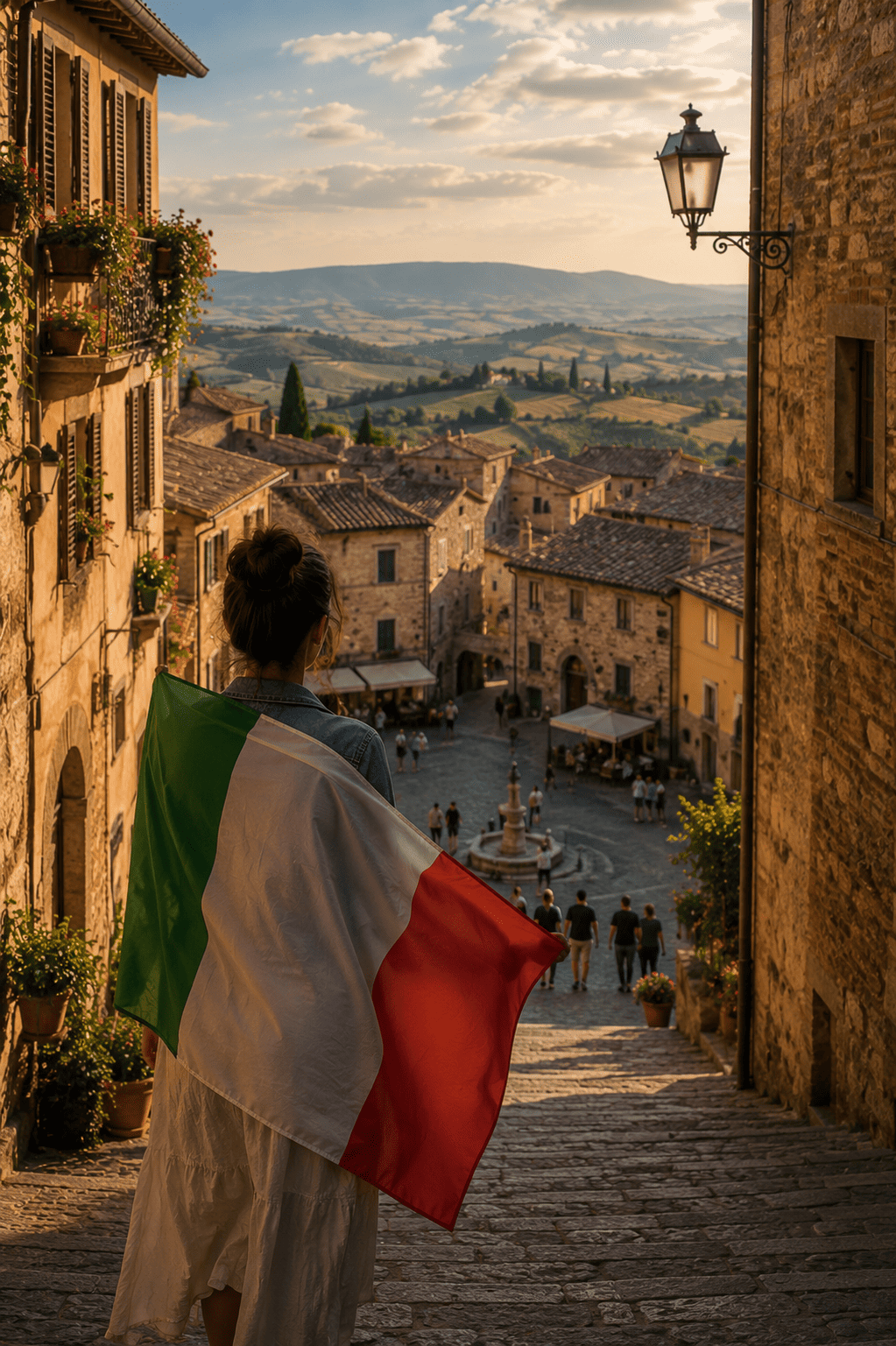
Why do Italians often feel Tuscan, Sicilian or Venetian...
before they feel Italian?
When you meet an Italian for the first time and ask “Where are you from?”, the conversation rarely ends with “I’m Italian.” More likely, you will get a much more precise answer:
“I’m Sardinian, from Cagliari.”
Or:
“I’m Tuscan, from Siena.”
“I’m Neapolitan.”
“I’m from Milan, but my parents are Sicilian.”
And from there, the conversation may move on to the city, the region, the accent, the food, the differences between northern and southern Italy, or even what life is like in a particular neighbourhood. To a foreigner, it may seem curious that, when Italians talk about Italy, where they belong tends to come up so quickly. But this is not simply a matter of local pride or campanilismo: behind this way of introducing oneself lies a much longer history.
A country that came after its identities
If we look at a map of Italy today, we see a compact country, with clearly defined borders and a single state. It is an image that seems completely natural to us. Historically, however, it is relatively recent.
For much of its history, the Italian peninsula was not a unified state. Instead, it was made up of kingdoms, duchies, republics and cities, often politically independent and with very different traditions, institutions and interests.
Venice had its own political and commercial history. Florence had developed its own cultural and political identity. Naples belonged to yet another political reality. Sardinia and Sicily followed different historical paths. There was not yet an “Italian” identity in the modern national sense of the word. Instead, there were concrete communities to which people belonged: a city, a territory, a language, a tradition.
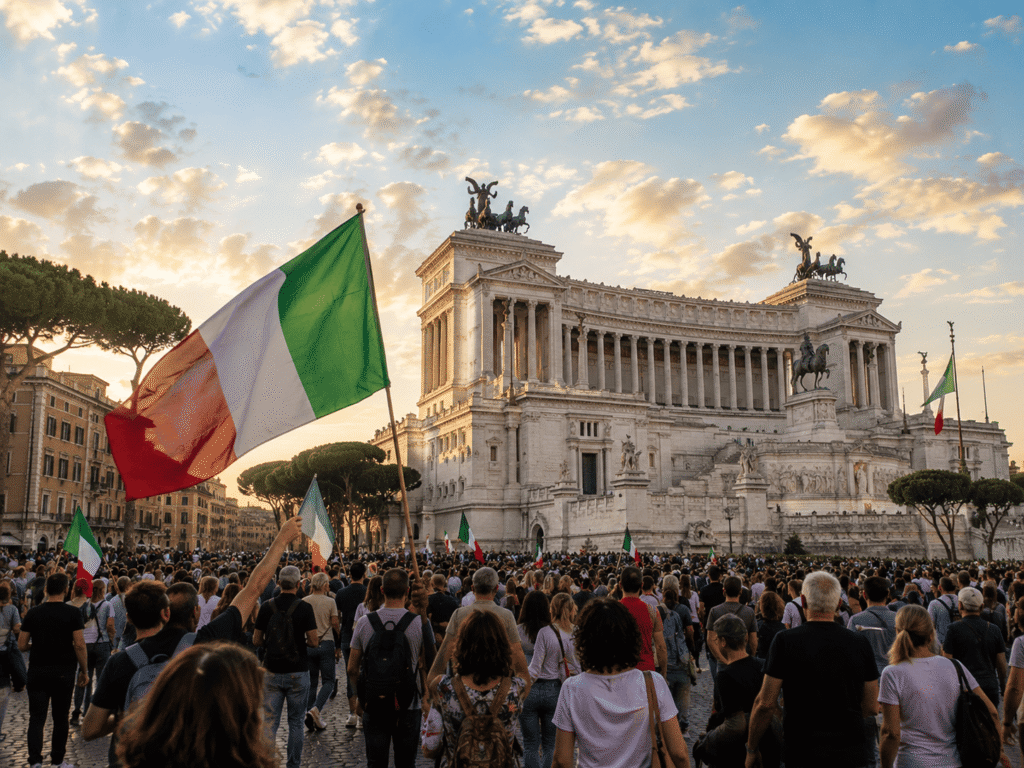
When the Italian state was established in 1861, something rather unusual therefore happened: the unified state came after local identities that had already existed for centuries.
This is an important difference from other European countries, where a sense of national belonging developed more closely alongside the formation of the state. In Italy, at least to some extent, the process was almost the reverse. First came the local identities. Then came the Italian state.
What does it mean to feel that you belong to a place?
This is where a word we often use to describe Italians comes into play: campanilismo. Campanilismo describes a strong attachment to one’s own town or territory, often accompanied by the conviction that “we do it better here.” It is what can turn an innocent question such as:
“What is the best Italian cuisine?”
into an endless argument. The pasta? Depends on where you come from. The bread? Depends on where you come from. Pesto? Better not even start. Carbonara? Now things can get delicate.
At first glance, these may seem like arguments about food. But if we look more closely, they reveal something more interesting: the desire to defend a tradition and assert the value of one’s own territory. Food, in this sense, is not simply food. It is memory. It is belonging. It is a way of saying: this is the place I come from; this is the history I recognise as my own.
The same is true of dialect, popular festivals, the landscape and even ways of speaking. They are all elements through which a community continues to recognise itself.
Does saying “I’m from Puglia” mean “I’m not Italian”?
No. And this is precisely where the original question can be misleading. Saying “I’m from Puglia,” “I’m Sicilian” or “I’m Venetian” does not necessarily mean putting Italian identity in second place. The two identities can simply coexist. A person can feel deeply connected to their own territory and, at the same time, consider themselves fully Italian. In fact, they may simultaneously have several levels of belonging: local, regional, national and even European. Perhaps, then, it is more accurate to speak not of identities that exclude one another, but of identities that overlap.
There is no need to choose. Being Italian does not erase being Emilian. Being Italian does not erase being Neapolitan. Being Italian does not erase being from Turin. National identity includes local identity rather than replacing it.
And perhaps this is the most Italian part of the story.
There is an interesting paradox here. Italy is often described as an extraordinarily diverse country: accents, dialects, food, landscapes, certain habits and even the way people relate to their own territory can change considerably from one place to another. And yet this variety does not necessarily prevent people from feeling that they belong to the same country. In some way, plurality itself has become part of Italian identity.
This is also why regional differences can be so important in everyday life without automatically becoming a rejection of national identity. When an Italian says:
“I’m from the Marche.”
they are not necessarily saying:
“I’m not Italian.”
They might simply be saying something more precise:
“Before I tell you about Italy, I want to tell you which part of this story I come from.”
So: do Italians feel regional first and Italian second?
Perhaps the question itself is badly formulated. There is not necessarily a hierarchy in which regional identity comes first and national identity second. Rather, there are different histories that have accumulated over time. A person can be Roman because they were born and raised in Rome, Italian because they belong to the Italian state, European because they recognise another dimension of their identity. One thing does not cancel out the other. And perhaps it is precisely this overlapping of identities that explains one of the most fascinating aspects of Italy: a country that managed to build a national identity without completely erasing the identities that existed before it.
Italy, in other words, did not come into being all at once. And perhaps it continues to be Italian precisely because it has never been just one thing.
Would you like to continue this conversation in Italian?
If you study Italian at an intermediate or advanced level, learning about Italian history and culture can become much more interesting when it gives you something meaningful to talk about.
In one-to-one lessons at Magnifico Mondo Italiano, this is exactly where we start: with history, art, literature, society and the many contradictions that make Italy what it is, turning them into opportunities to speak Italian naturally and with greater confidence and complexity.